-->
Showing posts with label carcerus. Show all posts

Friday, September 21, 2018

Worldbuilding: Vignettes from Carceral Place, and a rough table


some here are more isolated than others, their cells a good distance from the forums.

there is a banished scholar kept in an alcove inside a large domed chamber, the ground an alternating board of dark and light diamonds. the dome is large, and in the very center of it is a small dark circle. the scholar is found under this circle, looking up into it. 

very rarely this tiny circle, they say, shows pin pricks of light against the dark. they have looked at this for what must be years now. they have reasoned that this hole is an opening to the night sky, and the spots of brightness that fill it are celestial bodies.

they say the brightest one is the old world, the world all here have been taken from.


there is labor duty as well as watch duty. labor will involve dismantling bridges, sealing off passages, affixing blades and spikes to otherwise safe areas, arming booby-traps and preparing other hazards. If you are clever you will know of potential dangers, and might be able to sabotage them in advance. 


it is almost never quiet in this place, there are ceaseless echoes from hundreds of feet away in every direction. unexpected whispering galleries occur, faraway clangs of chain turn into bell tones, distant shouts become wordless tones.

the world around is built chaos too, an endless tangle of structure is dizzying. you have to learn to narrow their focus to avoid confusion.

imagine standing on a balcony that overlooks a series of arched bridges crossing at right angles, between that are narrow decorative archways, between them are also columns of various widths and heights. There are arcades you can see deep into, some duplicated with dead ends. There are blind arcades carefully carved to appear to have depth, and ledges carefully sloped to be useless and deadly.

This tangle continues both and and upward as far as your can eyes can peer in the dim light. Some areas are filled with large structures too, ziggurats and mausoleums, alcoves, basilica. Some immense columns are in fact structures, hidden stairwells and chimneys.

Chains and ladders hang just slightly out of reach, or reach just shy of where you would go. Things just far enough apart, or far enough away, to make drops and leaps into suicides without careful examination.


you may never be unwatched, as up and down in all directions there are ledges and hideaways where someone may be watching. This could be a benign fellow prisoner, or a scold noting your infractions.


those who refuse the food are changed. They become monsters worse than the pests, armored and many-limbed things that stalk the halls and wreak havoc.

This is the incentive to do as one is ordered while on watch or labor duty. The armors worn leave you unable to eat, which puts you at risk of having your humanity confiscated if you refuse to do your duty. Poor performance can lead to longer shifts, increasing this danger.


while wearing the armors of watch or labor you have no voice for other prisoners, but all the voices of those doing watch with you can be heard echoing inside the helmets, and you can be heard by them.

Very Rough Table

the basic premise of this place is that there's a potential way to go to almost every direction, but you'll need to "read" the structure to do it safely. You'll be doing everything in "dungeon turns" because of this, and can sort of map it as you go.

So, you are standing on an archway, and you want to go up. You spend one turn looking around to roll an Architecture check. If you succeed you roll on some tables. 

e.g. The Way Up
1. 1d4 x 5' away, across a chasm
2. on a column
3. down one level
4. 1d4 x 30' further down this way.
5. across a plaza
6. past a barred tunnel
1. a low chain to climb
2. a spiral stairwell
3. a wall with grippable stonework
4. a staircase
5.  a ladder
6. a cage on a pulley

1. to a ledge
2. to an alcove
3. to an arch
4. to a tunnel
5. to a plaza
6. to a column

So, there's a way up: a low chain to climb hanging only 5' away, it leads up to an alcove. You take turns jumping onto it and pulling yourselves up

Or there's a spiral stairwell on a column, it goes up to a plaza.

Or down one level is a staircase that goes up to another arch.

There will be difficulties too.

1. 1d6 x 2 Watch are there.
2. The stonework is crumbling
3. It is very dark.
4. There is a pest there.
5. It is tiny, with only room for one at the top.
6. It is a long distance.

So, you might see a wall with grippable stonework 120' down this archway, and it leads to a ledge. but, it's so tiny at that ledge that only one person can stand there at once.

Obviously you'll have several Prisoners checking at once, so you may end up with various routes. Choosing which route is best is what'll be interesting.

So, climbing up to that ledge will seems better than crossing that 10' chasm to reach a plaza with 6 Watch in it, even if that tunnel seems promising.

Some results lead to other tables (eg "how do we get across that chasm? how do we get down to that staircase?"). Not every result will be tenable either, but that won't be a journey-ending problem. You'll just have to keep moving, or go back a bit and try again.

You'll want to keep notes too, "go archways to the tunnel, climb down then follow the ledge. Past the fountain go into the alcove across the plaza. climb down to the courtyard full of moss and take the ladder up...". You'll need to repeat your journeys if you want to ever find a way out.

Wednesday, September 19, 2018

Worldbuilding: The Watch in the Carceral Place

the carceral place wears down the spirit of the imprisoned with its unending cycles

the watch are one such consistent thing, while it is unpredictable where they'll be seen (and for how long) it is known that they always will be seen somewhere. it could be anywhere.

the silent watchmen are as permanent as the stones, just in a less fixed position.


a pair appeared on the other end of a drawbridge, one that gave you only a precious minute or so to gather up some flavorful red growths on that column it led to (otherwise, it was a dead end. a 10 diameter thing with a mere few-foot wide ledge for a walkway, with the bridge up you would be trapped, hopeless)

the growths on that column were a necessary toll for passage, the only way you would be permitted through that plaza, the one with the chain that hung just low enough for you to climb up to the archway leading away to a potentially useful stairwell.

or at least you thought as much.

it could not be said if these watchmen were placed there because it is true that the red growths you would use to cross the plaza to reach the archway were needed to reach a stairwell that would certainly lead to a way out from this place (at least eventually), as all prior sets of watchmen had impeded you reaching dead ends.

they may have simply appeared because you had been seen repeating this infraction too many times*, of leaving the plaza, crossing the drawbridge. gathering up red growths. it is all infractions, and their presence could be a mere punishment.

*it is known that you are not always watched in the carceral place, just that you always might be.

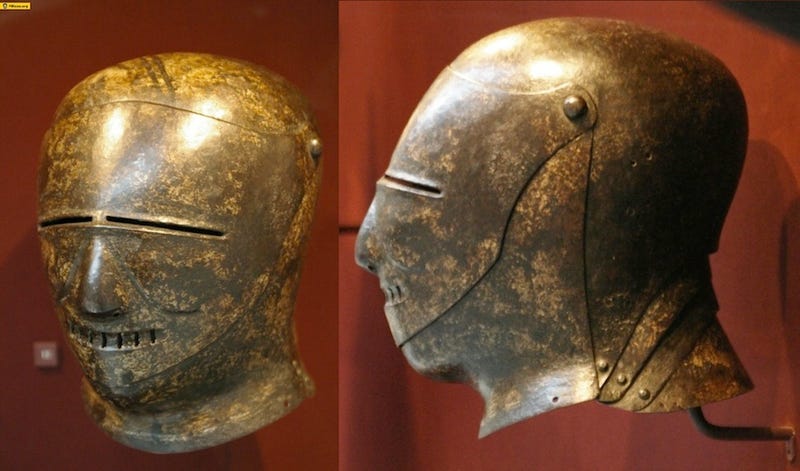
the watch are distinctive, unmistakable. their heads and faces are shielded, covered by grotesque helmets attached to shoulder and chest armors. this region of the carceral place presents its watch as mask-faces with crude, ugly expressions: these two smiled. they turned their chests and heads to face you. they are without speech.


watch are not often fast or agile (unlike the pests), as they are weighed down by the bulkier armor they can't remove, and often (as was the case with these) heavy armored robes.

Robe, Velvet, metal wrapped thread; embroidered


They carried simple weapons, staves with fat weighted heads, their purpose clear: they would clobber you, smash your skull and ribcage, toss you into the dark tangled abyss of structure below.

you reasoned that if you were able to push one off the edge with a good bash of some kind, and then not get tripped up by the other right after, it would then just be a matter of scraping off a bit of red growth as you moved around the column.

if you were able to get around and then back to the bridge without running into that second watch as  you did that, you would then easily outrun them.

this is what you would do then.

they readied their staves as the bridge lowered, and you pulled loose a cracked piece of stone ornamentation you had seen previously.

you heave the weathered knob into the solar plexus of the leftmost watch, and then you charge as they begin to tumble off the narrow column ledge from the blow. their bare arms and legs splay wildly as they appear to float off the edge of the architecture, their staff balancing for but a moment before joining them in the abyss as their robes ripple like sails.

they make no sound, but the second watch clangs their staff against the column, just above your head.

you rip out one handful of red growth, then two. you cannot see the watchman. you cannot hear them.

you wonder: would they have followed you around, or would they have turned face to charge you in a new direction?

you are certain they would not turn, and so you continue round the column.

and you see them, they are on the bridge. they did not follow you at all, and you are a fool, and the impact into your solar plexus is sudden and awful as the staff smashes you into the column before you crumple and fall into the dark as well. you barely take in breath before it is over.

and when you awake your breathing is far too loud.

your arms reach up and feel cold metal, and fumble over the integral locks that hold the grimacing helmet on your head when you find them. you arms are slowed too by armored robes, gaudy and worn down by time and many wearers. they smell like old sweat, the helmet like rust.

at first it was awful to take watch, excruciating. you would have wept, begged forgiveness if your voice could be heard. it is not like that anymore.

none ever speak of taking watch, since there is nothing to say. all here commit infractions, and so all at some time have taken watch. and shall again.

all here have thrown each other into the darkness, have cracked each others ribs and skulls. all here have been the cruel gargoyles watching over each others passage.

you understand that if you let them use your body for now and do as they will say they will at least not change it, or this will at least delay them changing it. at least this is understood, and so it is easy.

you will be able to eat and drink too, when the helmet is removed.

your infractions were not great today, and so you hope you will not be asked to do too much in penance.

though none will know that it was you, but it could of course be any one of you, and so it is always you.

and if you do this thing they ask of you they will let you return to your cell as you had died normally, without infractions. awaking as usual, barely clothed but without cruel assignments.

you listen for the creaking sounds of the many limbs of a warden as you rise up, testing the weight of the staff in one hand, and feeling a dent in the sternum of your armor with the other.

Wednesday, August 15, 2018

Worldbuilding: Cells in the Carceral Place


You entered this carceral place alone, by waking in the cell. The cluttering sound of stone onto stone is what woke you, a wall (or part of one) dissolving, to reveal how you were cloistered away. You rise off your low bench, your eyes adjusting to the dim. There is some low light coming in from somewhere, trickling from an architectural folly nearby.

There is a drip or trickle somewhere of fresh water, and it falls into an urn or bowl or basin (you soon will see this in all of them, all the other cells you find).

There is always growth, a fungus, lichen, or mold. It tastes like sour yeast, or cold boiled bird-meat, or the pungent tang of indigo-veined cheeses. It grows on some conspicuous place, it is deliberate. It is what you will eat in here. (and you'll see there is, thank the gods, frequent exchange between cells).

This place is your place because no one else can enter it. You have tried, everyone has, and the door always closes. You will always be alone inside here. You are safe in here.

There is food, there is water, and time passes. It is cool, not cold. Dry but not dusty.

The cell is square for some, others are arched, some have high ceilings, others are round chambers. Yours is clearly yours, but is still similar to others. Especially those close to it. All of them are like this.

You are not without entertainment, sometimes there is a stub of chalk or charcoal (though all marks that are left vanish when you sleep). Elaborate line-work and patterns are common, despite being so temporary. Some days a lump of clay, a shining ball, a few resonant rods of hollow metal. These stay and go sometimes, or they are traded, or borrowed. Games form in common areas. There is camaraderie, there is enmity, sometimes there is violence. Societies form and crumble around activity in these common areas.

You are free to walk the hallways here, cross the plazas, go between the vast columns. You may go under archways and up the stairs, or down them, and sometimes you find only walls, or places in ruin and about to crumble. Other times though, there are things worth finding.


You have seen whole chambers of moss and great troughs of vegetation tended to by others who live here. There were lightless tunnels, and even (oh wonder of wonders!) a window open to perhaps endless black sky, a hint of distant light (a moon? a fire?) reflecting on still water, a salt and murk in the air? It was too small to fit more than a hand through, but it was a precious place.

Many regions are broken and breaking, while others are stoic and pristine. Tile, stone, cold metal, iron and stone sculpture. Intricate stone carving and brickwork. Raw stone and cold water. Smoke and ashes and old fire. Smoke, mist, echoes. A language formed out of thousands of disparate tongues placed close together, close to what Christians would call the tongue of Babel.

The arches and stairs and flues and chains and walkways and catwalks here go up higher than a cathedral, all walled in with stone and lit with intermittent torches and candles. Great brassy bowls are like pitiful dwarf suns in the better sections, others are cold and dim with only tiny spots of light like cats eyes in certain corners. You've seen lamplighters in long robes, and have never spoken to them (a superstition you don't want to test).

It is said that if you go up you will find the most wondrous of beings in elaborate and inescapable terraria, and that if you go down there are the embarrassments and shames of the gods in black oubliettes. It is idiocy and glory to seek either of both. It is also possible to free them, goes the reasoning, since are clearly locked away.

You've seen forbidden things: parts of the "wardens" and "watchers" and other "guards" among the broken structures (or broken apart by some unknown cause).

You've touched these things, torn between the feeling of safety a weapon gives while being made uneasy knowing you might be seen with them. To hold contraband is a constant battle, you have heard. You've seen others speak of dedicated armies.

You have also seen the evidence and effluvia of the many uglier things that also wander here, the wretched things that keep most inside their cell, yourself included. 

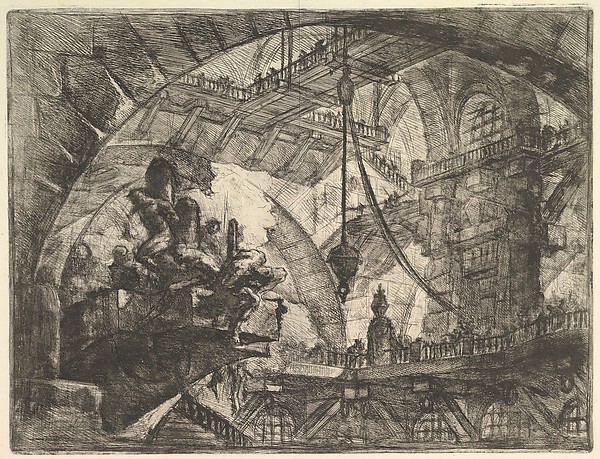
Prisoners on a Projecting Platform, from Carceri d'invenzione (Imaginary Prisons), Giovanni Battista Piranesi (Italian, Mogliano Veneto 1720–1778 Rome), Etching, engraving, sulphur tint or open bite, burnishing; first state of four (Robison)

Something once sat at the edge of your own dwelling for what could have been days. It had crawled and crept through the plaza on its limbs to your threshold, a wide mouth hanging open just so, eyes impassive but with a posture indicating menace. Larger than any man it moved like insects do, as you remember "insects" (there are none here). It sat there and was watching you, and you tried to not look at it too often. It never moved, though you knew it could. You awoke one day and it was gone. You were not sure if it had followed you here, or was only wandering through. None knew where it had gone. There are stairways everywhere, archways, tunnels, catwalks.

Some time later you gathered in the plaza again, and then some days after that you wandered the halls again, as almost all eventually do. Many things wander.

You are not certain if you have died here, though you've been told it is the same as sleeping. As with sleeping, when you die you awake inside your cell (no matter how far you have gone). Though unlike with sleeping, it is said that you can only die so many times (some say 12, or 14, or 37) before "you" are really gone, or at least sent somewhere deeper. Some are certain dying changes you also, but there are so many strange kinds here you cannot say who might have changed. Cells sometimes wall over when none are watching.

It is said that if one is daring enough there is the day-long path: a way out. If every correct step is taken one could be out of here, far enough away to sleep without worry, and awake somewhere new. This is why some wander, and learn the secrets of the structure. Perhaps there is a thing that can carry you away: a moth like a ship or a thousand angelic little birds (you still remember birds). Others use reason and mathematics to demonstrate why this is foolish, and will drive you to despair. This place goes on not forever, but far enough. Simply count your steps.

Still, those who are clever and wise and talented can guide you, they find ledges and gaps and loose stones. They find fast passage over vast areas, these architects and climbers. You seek them eagerly, even if some think this place may change when no ones looking.

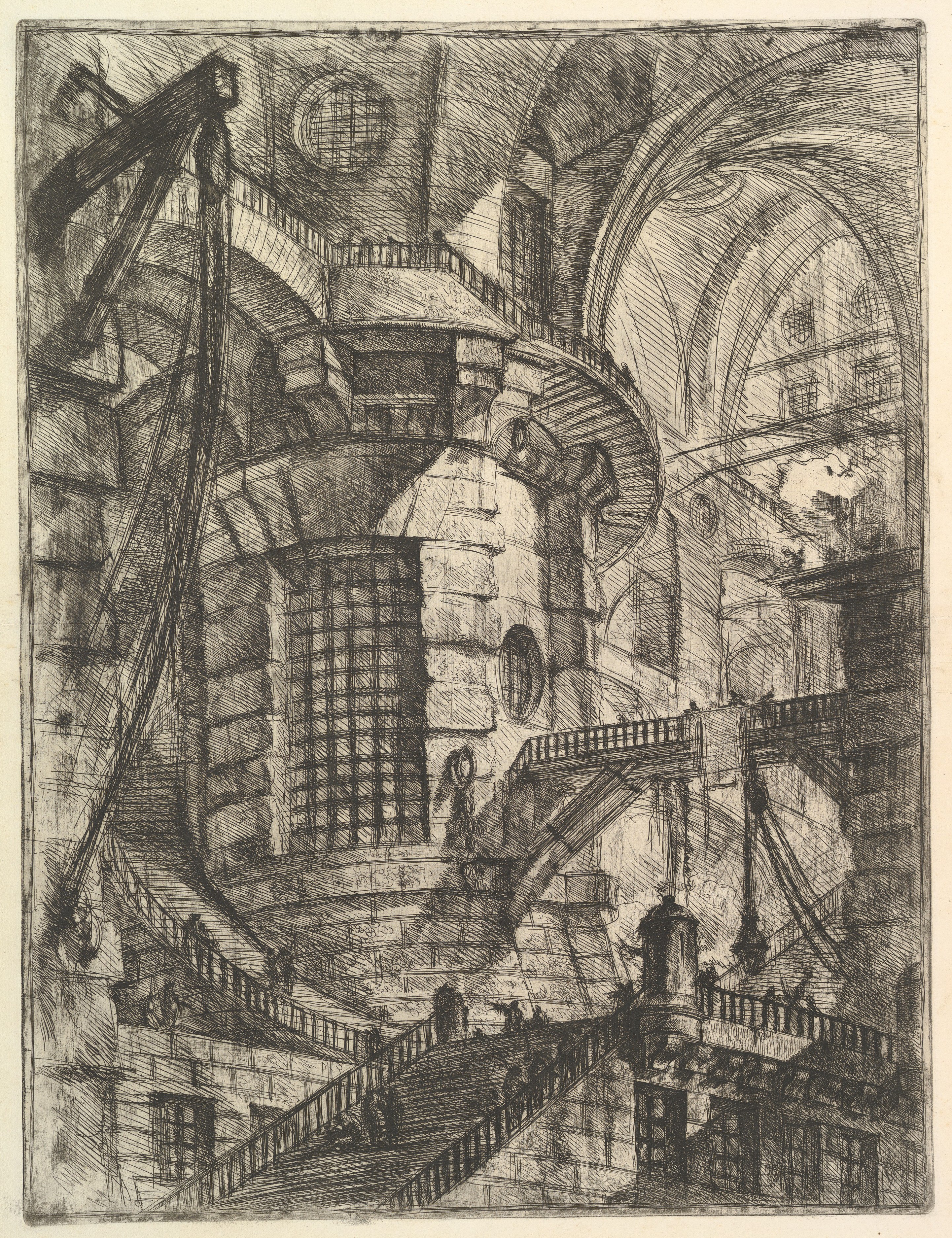
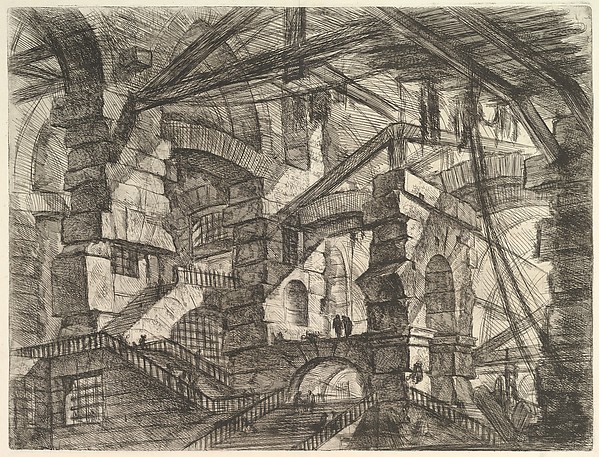
The Round Tower, from 'Carceri d'invenzione' (Imaginary Prisons), Giovanni Battista Piranesi (Italian, Mogliano Veneto 1720–1778 Rome), Etching, engraving, sulphur tint or open bite, burnishing; first state of four (Robison)

You once saw a broken drawbridge over a vast darkness. You threw stones into and heard no sound. You though of jumping in, eager to know what was there. You stopped when you realized you could not say for certain that you had never died. What if you had been killed when you were sleeping oh so many times, kept in place by being watched? Some things here wait for easy prey. How long has it been?

Time here is loose and memories are uncertain. The dreams you can remember never go past these walls, and some of those visions were the memories of an insomniacs wandering strolls. You've found places from these dreams down ways you've gone on impulse, or guided by various kinds of deja vu. You've found horrors too, halls of punishment that kept you waking for many hours, you've fled things that you can't describe.

It is said there are places here with secrets thought too noxious to even be kept in the world, so they were put into this one. Like you, and all the others here. You offended the sensibilities of power, enough to be thrown so far away you can't even be seen by your own god.

Others say different. This is the only world, and anything else you remember has been a dream. All sun, all rain, all fields and flowers are things that never were.

You were born when you woke here, and this is all there ever was. You have always been inside here. And any crime you recall, any furious king, any conspiracy, any theft? All false things. 

There was no magic, no spell, no imprisoning flowers. No tryst, no transgression, no defeat in the unjust war. There was no banishment to this place, no accident of travel. You never did anything wrong, and so there could be no such thing as a way out.

Others, naturally, disagree.

You are one of them.

You shall leave.
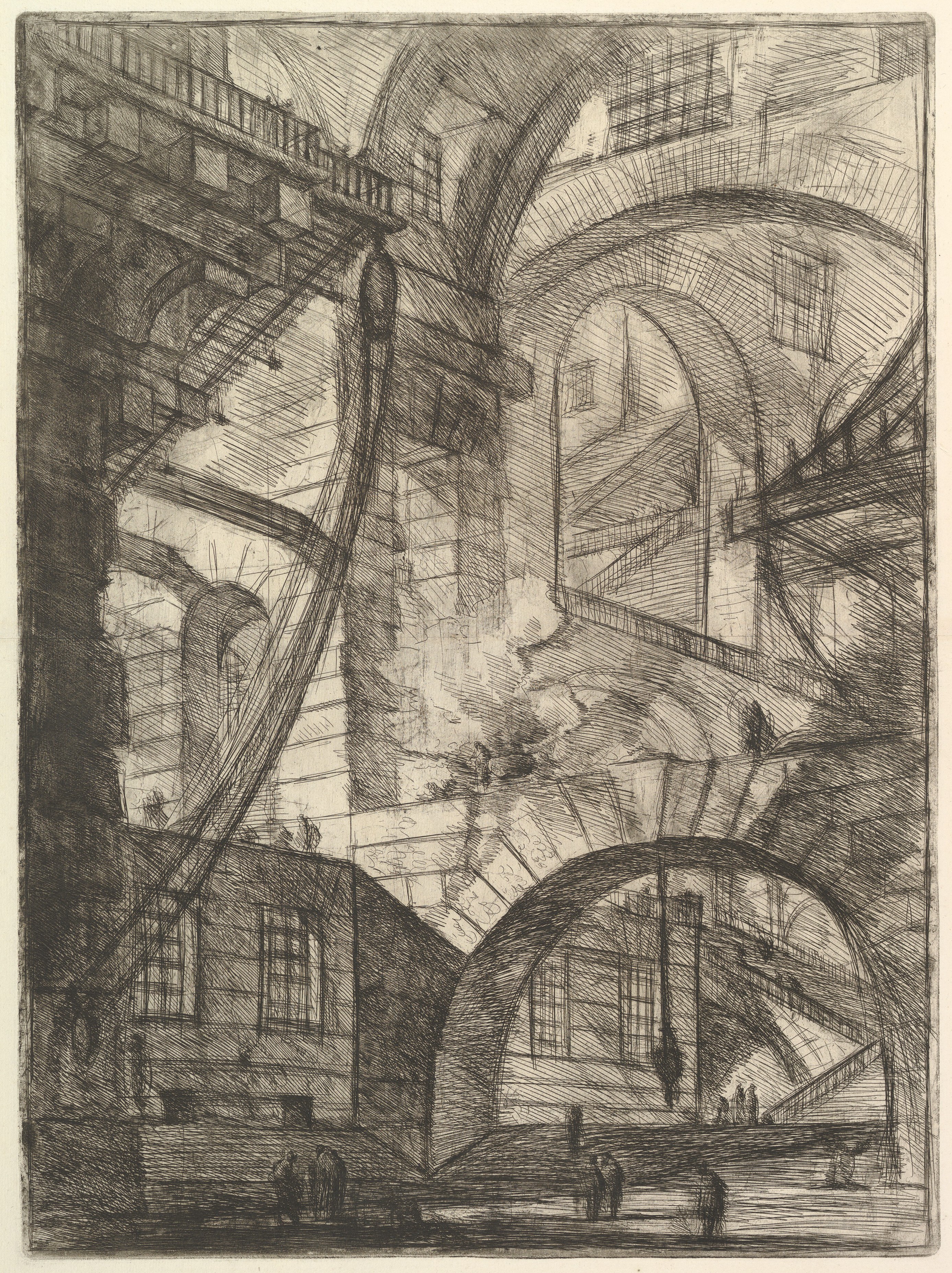
The Gothic Arch, from Carceri d'invenzione (Imaginary Prisons), Giovanni Battista Piranesi (Italian, Mogliano Veneto 1720–1778 Rome), Etching, engraving, sulphur tint or open bite, burnishing; first state of six Robison)