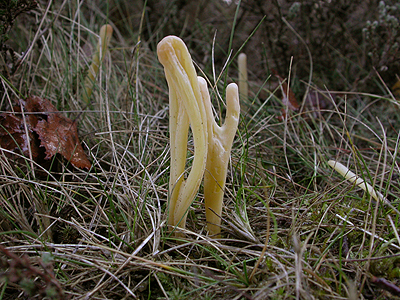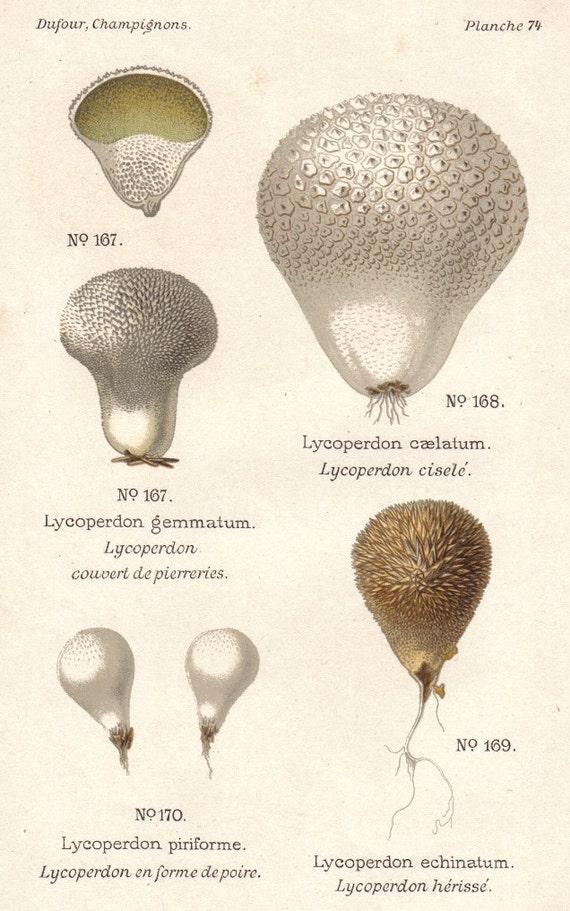
They grow in the same places season after season, like subtly wrinkled stones that appear in the grasses. Smallish at first, expanding to full size over several days, always a white-gray or brownish color. Some grow to the size of chicken eggs, others are bigger than a human skull. A rare few large enough to be small boulders, bigger than a tree stump or a horses head.
They are much lighter than stones, and their outer skin only papery shell. This is often smooth, sometimes faintly scaled or warty. It can be cracked and then peeled, showing a second layer that is like eggshell, but rubbery. Beneath this is a dense foam, moist, the texture of tofu or marshmallow. Whitish and sometimes tinted with faint yellows or browns. It has a faint but pleasant smell.
They are only barely tethered to the earth by a small tangle of threads, coming from an inconspicuous nub-stalk on the bottom. When winds are powerful enough smaller ones come loose and roll freely through the fields.
Left undisturbed all meadowbreads eventually harden, crack, and split open. Their interior will have darkened some, and then goes to the color of tobacco. It all crumbles into a loose powder. The smell of their decay is putrid and nauseating. In especially fertile seasons it becomes overpowering. This dust can even a sickness if it enters the nose and lungs.
The harvesting of meadowbread is an old tradition. It is still easy to find peasants who have preserved themselves with it in times of famine. Idle children and grazing animals will eat it too, and most shepherds are happy to see them gathered up for food rather than smelling it all rot.
Eaters of meadowbread sometimes emit a faint but distinctive odor for several days after. This leads to mockery in some places, an insult based on the assumption that only a lazy fool would resort to eating meadowbread instead of grain.
In other places they are used as medicine, the powder insides used to staunch the flow of blood. Cut into slices and pressed into flowing wounds, they form thick scabs over even deep gashes. This causes the distinctive meadowbread stench in every case, but few would ever use this as an excuse to mock a wounded soldier.
When the insides are still white meadowbreads can be eaten. They can be chewed up raw, but are better fried in fats or simmered in hot broths. Their own flavor is plain, but they absorb the taste of any juices they are cooked in.
There are eight known sorts of meadowbread.
1. Pathbuns, Travelers Biscuits
These grow in clusters, small enough to fit in your palm, near roadsides. When found there is usually enough to feed 1d6.
2. Soft-Eggs, Lonelybirds
If you spend all day in a field that grows them, you will gather enough to feed 1d4. They are egg-sized, and grow far from each other, and have a felt-like texture.
3. Boulderbread, Lordsloaf.
Enough to feed 4d6. You need not search for this meadowbread, as it is always too large to be hidden.
4. Pale Toad, Mace-Heads
Feeds 2d6. Fairly large, like a human head, and bumpy-scaly like a toad.
5. Beetcake, Purplepear.
Enough to feed 1d6 can be found in a few hours. The outside crackled like a good bread, the insides like purplish chocolate cake. The most lovely flavor of all the meadowbreads.
6. Physicians Bread, Physics Manchet, Chymisloaf
Unlike the others, extremely low flavor no matter how it is prepared. Grants another Save vs Disease if eaten, and more prized as a styptic.
7. Roundmouse, Sparrowbulbs.
These small brownish bulbs grow in clusters, and only provide enough to feed 1d3.
8. Meadow-warts, Bandits Biscuit
These spiky, bumpy things grow up on a tiny stalk. They profilerate wildly, with enough to feed 1d8.
SPUMARODUS
It began long ago. From a central tumorous knob a tangle of billions of pale threads meandered through the darkness of the earth, growing upward to the sun. Growing millimeters over months, wrapping round subterranean nutrients like a shroud, strangling earthworms, weaving into the roots of living grasses.
It has formed a body in the land where these threads are concentrated, immense and immobile. It feels the footfalls of things on its skin. The green grasses are it’s pelt. This is also its tongue, it tastes the world above absorbing droppings and remains. This is how it understands, it learns from eating all detritus. It sucks on the ground around it, pulling fertility into it as fuel for inefficient growth. This leaching weakens the soil, causing poorer harvests and then famines in less verdant areas.
This is a Spumarodus. One could surround a whole city, silent and unseen, merely by expanding through slow growth. Their growth is almost unstoppable. They are only unable to grow their threads near trees, in sandy earth, or under salty water. Eventually it will drain the earth of all that is edible, then wither and die or fall into a torpor until the earth regenerates. They depend on ambulatory creatures to spread to farther places. Meadowbreads are reproductive tissue grown by a mature and established Spumarodus.
The things that eat the meadowbreads become innoculated with their essence, causing a temporary stench until the humors return to balance. This eater has now become a seed. The Spumarodus then grows a the second organ, called a swain. This is an imitation of a surface creature, growing from the earth in a secluded place, and then finding its way to its seed. The swain eats the seed, and then fertilizes the earth below. They rapidly decompose into an oily paste that is absorbed into the ground and forms a new instantiation of spumarodus. The cycle begins again.
1d3 days after a meadowbread is eaten, those who ate it must Save against Magic. If this is failed they emit the distinctive stench of meadowbread for 1d3 days, and are also who the swain will be bonded to. If used to treat wounds infection is automatic.
Each type of meadowbread is from a different kind of spumarodus, each of which has a particular kind of swain with a particular method of acquiring seed.
COMMON FEATURES OF ALL SWAIN
Most swain appear to be humans, though some are not.
In all cases swain appear normal from all outside views. Under their skin they do not have bones or muscles, but are dense enough to seem like it. Their inner flesh is a rubbery foam, like a meadowbread. They have a hollow tube inside them from one end to another, so they will be able to pretend to eat well enough to match expectations. When relevant, they have enough of a mental life to appear to be a mere human. They are unaware of their true natures. If forced to introspect they would realize they have no self control. They are not prone to introspection.
Each type of meadowbread is from a different kind of spumarodus, each of which has a particular kind of swain with a particular method of acquiring seed.
COMMON FEATURES OF ALL SWAIN
Most swain appear to be humans, though some are not.
In all cases swain appear normal from all outside views. Under their skin they do not have bones or muscles, but are dense enough to seem like it. Their inner flesh is a rubbery foam, like a meadowbread. They have a hollow tube inside them from one end to another, so they will be able to pretend to eat well enough to match expectations. When relevant, they have enough of a mental life to appear to be a mere human. They are unaware of their true natures. If forced to introspect they would realize they have no self control. They are not prone to introspection.
They are not affected by poisons, and do not need to breathe (although they will pretend to). They have a blood-like substance pumping in them, just slightly darker. They are dense with energy, and supplemented with nourishment from sunlight. They do not sleep, but imitate it as needed.
When any swain is reduced to 0HP it imitates unconsciousness, but when reduced to -4 begins to rapidly decompose into tobacco colored sludge. They heal at a normal, human rate.
When doing this they ripen, transforming over moments. A ripe swain reeks of rotting meadowloaf. It is pale, deformed, swollen, and disproportionate. When injured their rotting foam spits out in a great gout.
Roll 1d6 for each point of damage a swain receives, when it receives it. If the total number rolled on these d6 exceeds the Constitution of anything within melee range they must Save or lose 1d6 HP. This is from choking on spores, and will “heal” fully within a Turn.
Their disguise is flawless without close examination. However, whenever the maximum number on a damage die is rolled for an injury to a swain they have received an injury that looks like it should be instantly fatal, like an arrow straight through the head, regardless of if they are at a low enough HP to indicate death.
All swains have a condition during which they will immediately try to consume their seed, becoming mindless monsters.
Pathbuns, Travelers Biscuits
1 HD (with 5 HP per) for every seed.
These look like plain humans in all ways. They are found in a helpless state, a barely clothed body lying in the field, near the roadside. They barely know how to move, and cannot speak. They depend on passing samaritans.
Once human skin touches them they learn enough to complete their disguise. They know their name then: Nirno, Biur, Fald, Myse. They know enough to somewhat mimic others, stilted social manners and subtle awkwardness. They are outsiders, they do not remember anything before they were found. A dim-wit, but lovable. Mild mannered. Humble.
They become a loyal companion to the Adventurers that touched them, and will travel with them for as long as is needed.
These swain consume the bodies of a seed after it has died. As soon as their seed dies the swain will want to be alone with it. They will gnaw and rip off portions of the dead seed, crumbling as they consume it, melting into the dirt.
They will become agitated if questioned or delayed, they will lash out violently if impeded. They will become a ravening ghoul that will attack anything that tries to stop them, or witness what it will soon do, very quickly.
Soft-Eggs, Lonelybirds
1 HD (with 5 HP per) for every seed, Stealth 4, Sleight of Hand 4.
A stalking human seen for the second or third time at a tavern, or a distant someone always down the road. They will flee if chased. If caught they will not be able to explain their obsession, and why they must follow you. They might cut off some hair in a crowd. Their have clothes grown over them, simple shrouds. They steal and scavenge better clothes when possible.
They will continue appearing until you die, and even then they would dig up your grave. They prefer their seed alive though, and would try to take a piece of you when you are sleeping. Just a bit of flesh, a digit or an earlobe. They will run away to eat this, and crumble apart as they do. If threatened too strongly they ripen, and try to tear off what they must have before they run.
Boulderbread, Lordsloaf
3HD (with 10 HP per) for every seed, Armor 16.
This swain is a mighty horse, powerful, beautiful and untamed. It comes to you. It chooses you.
Only a seed may ride it. It carries them fearlessly, it defends them from attackers. Its hooves smash foes, it bites off the flesh of all who would harm you.
If a seed ever falls unconscious from injury it will try to eat them, after tossing off any riders. If resisted it ripens, lurching forward standing on just the back legs. The front hooves becomes wormy fairy fingers, the mouth spreads into something crocodilian. It hacks and roars, needing to devour at least most of a whole mody before it can turn to slime and fertilize the earth. It would prefer to devour more.
Pale Toad, Mace-Heads
2HD (with 6HP per) for every seed
This will be someone the seeds have seen before. A familiar face, from their memory. A friend. They will be found somewhere, confused as to how they came to be there. It must be someone they have met in play, not in imagined backstory, so they might see a double of the last kind person from the previous town, if not just nodding interloper they passed along the road. They will have the same clothing, all the usual things they would carry.
Confused by their predicament, they will want to travel with the Adventurers. In their seeming normalcy they might become a friend.
They will try to eat a seed once they are alone with them, at the first chance. They ripen into large ogre-like abominations.
Beetcake, Purplepear.
1 HD (with 5 HP per) for every seed.
This will be someone who has recently died in the area, such as a victim of banditry, famine, or plague. They don’t know much, they know what they were, but they also know they want to be with you now. This causes distress in the community if they are seen again, appearing as not only a ghost of sorts but one gone mad. There is much trauma, sadness, wailing, and eventual acceptance (perhaps), when they leave with the seeds.Once taken far from their originating population they try to eat them.
Physicians Bread, Physics Manchet, Chymisloaf
1 HD (with 2 HP per) for every seed.
An archetypal wise guide, some amalgam of old elder figures. A plausible sage, or some other figure who would know.
They by chance know something about the thing you are looking for, they might even commission you to help find it. They will lead you on a wildly divergent journey, taking you far away from anything useful for 1d4 days. At nightfall on that last day they go feral, getting one tiny sample of a seed before they crumble. Merely stabbing one and licking the knife is plenty. They only ripen early only if you try to abandon the “journey” before the end is reached.
Roundmice, Sparrowbulbs.
0HD (with 1d8 HP) per seed.
An assortment of small creatures follow the seeds now, as if you were a dryad or druid. Mice and marmots and squirrels, sparrows and jays. If a seed is injured they swarm it, nibbling at the wound. Each creature has only 1 HP. but releases the same choking rotten spores when killed. They do one damage in their attack, before crumbling.
Meadow-warts, Bandits Biscuit
2d4 per seed, each with 1HD (3HP)
These grow into rangy, feral looking human simulacra. Unclothed and armed with improvised weapons. They all look somewhat related, almost like they could be your the seeds distant cousins. They seek to ambush and then tear the seeds apart for devouring once they reach the ends of where this Spuymarodus grew, but outside any civilized places.