
Most of this scenario playtested very well.
To give a broad summary: the Adventurers decided early on that they would keep the money that was given to them to purchase the special object with, so they buried it beneath a tree.
Then they did some espionage on the vagrants, determined they weren't worth talking to, and then stole the special something right out from under them. They also slightly vandalized the thing, neutralizing a potential curse they weren't aware of. There was a perilous cave that I had mapped out that they could have explored too, but they decided not to go inside it (this was the smarter thing to do, but still: darn).
They killed the leader of the vagrants (by accident), then killed two dozen of them with a carefully timed combination of spells (Wall of Force combined with Reverse Gravity is hideously effective if a lot of people are angry at you, and running).
A tagalong hireling of theirs was also traumatized with hallucinogens early on, and someone else was mauled by a delirious stag. The apocalypse was simulated with skinned bodies (this was the players idea, not mine).
To cap it off, once they got back to Aldercliffe they sent some mercenaries they had recently met out into those same woods under false pretenses in the hope of causing a massacre to clear the place out.
I loved how it all turned out. The players interacted with all the moving parts in this situation in ways I never would have predicted, and it produced a very memorable outcome for everyone. Why are you here? What more do you want from this hobby?
What didn't work for me was the whole "exploring a forest" bit. It just felt like a big room with some distractions on the way, like opening the door to a mansion and immediately seeing the high backed chair before the fireplace, with the weird lord seated within. You trip on an umbrella walking over. That's it though, you go and meet him. Ho-hum, too quick too easy.
The woods were far too small, too close to civilization, and too simple to get through. The Adventurers couldn't help but run into a situation and take it from there, and they basically got back in time for dinner too. It was fun to play through, but that part wasn't really special.
I'm revising it to make the forest much farther so it's more of a journey. The forest is larger too, large enough that there's a chance the Adventurers might think "fuck it, there's nobody here" after a couple days of wandering.
I'd like it so there's the chance they might get mauled by a badger and call it all off on day three, or maybe they might find a half-trapped fox and think they should keep looking. They might see smoke from a bonfire, another long day away. Maybe they'll run into someone in the woods that makes them want to reconsider everything just as they get near the edge of discovery. There's also a non-zero chance they'll just find the treasure on accident. How did it get there? They can keep looking for an answer for that if they want to know.
A dungeon is a closed environment with an entrance, a place with rooms followed by other rooms with hallways connecting all of them. Your options for movement and destination are finite and limited.
Much of the uninhabited and untamed world is like this. There are only a few ways you can actually "go" in a lot of natural environments.
Ground that's too steep to go up without climbing gear (and hours of labor) is functionally the same as a stone wall. Trees too dense to walk through and narrow paths on mountainsides are the same. There is natural light, sure, and maybe a source of food, but it's not too different than being trapped. Missing people die in the woods all the time. Even being able to bypass these kinds of obstacles with flight is only marginally easier than being able to escape a place with teleportation, after all.
The idea of an open-air dungeon is that it should be about as hard to not use the defined paths it provides as it would be to tunnel out of the more usual stone dungeon with mining tools. Not technically impossible, but a real piece of shit to actually do.
In nature, the pathway is the "hall" that lead to the "room". The "room" is an event or landmark. A mountainside path leading to a wider plateau, a rocky band of cliffside coast leading to a larger cove, a narrow canyon eventually widening to a proper valley, a hike in dense woodlands to a roaring waterfall. These are all Open Air Dungeons.
Wandering encounters make as much sense as those in a dungeon, think of hikers getting mauled by a bear. There are traps too, a landslide is natures spike-filled pit trap.
The natural world is a dungeon whenever you can't go in any direction you want.


Give your environment a name. It's not just "a canyon by a beach", it's "The Throat of the Ocean". Make it special.
There should be some plain old random encounters on a table, things there that will be run into by accident on the way from one room to another, or even in a room if one hangs out too long. In the Black Heart of the Southern Wood: there are Elk that went carnivorous, paralytic slugs the size of baseball bats, and hopelessly lost mushroom-pickers who will be very grateful that you found them.
And there are things there besides the pathways and random encounters, the special parts. Imagine a vast tidepool canyon, walkable in the low tides. If you go that way there's a stinging anemone the size of a house. It has the face of a maiden and will teach you enchantment. If you go the other way you'll find an immense band of gold in the walls of the rocks. Beyond that, they say there's the wreckage of a ship sent by the church, filled with relics now lost to the saltwater. If you go too far there's a bunch of sharp rocks though, watch your knees. This will be a table as well.
You'll have to decide how spacious a path actually is, but the aesthetic of your Open Air Dungeon will help with this. If the OAD is a mountain the paths can all be narrow with dense pines on either side, maybe just a a few meters at most. If it's an arid canyon it could be an ancient riverbed spanning more than 30 meters in either direction with nearly vertical walls on both sides. You get the idea.
Paths are drawn quickly using arbitrary rules, with as little thinking as possible beyond obeying the rules. You want to create something using a process instead of trying to design something conciously.
The basic rules are:

So there you go, this gives you a map with some various paths leading to various places where things will be. Once you decide the scale of the grid and travel time and decide how you'll fill the squares it's basically ready for play.
When it comes to stocking the locations you can key the whole map in advance, just use randomness to stock it. Roll dice, throw darts, whatever.
You can set it up so you can roll to reveal things as the map is explored during play, which is way more fun.
You can just roll off your table of content from earlier at each location. If there are some things that have to be present you can just make a "loaded" table to use during play. That means a few of the entries get written in, but the rest are "roll on this other table"
So, if this was The Forest of the Bitter Fruits and you definitely have to have the Red Tree of Bitter Fruits be there no matter what, you can make a table like this (for a map with 12 circles):
1. The Red Tree of Bitter Fruit
2-12. (roll on that d30 table of other things, don't repeat any of them)
and so on. If you added intersections to your map just choose them at random before play, of it all fits on a die load them into the table too. You can just fill in those circles on the map instead of numbering them.
You can make a whole Adventure around a map like this by thematically unifying your tables of content and giving them a way to play off each other and create a narrative. As Referee you'll have a notion of what might happen and you'll know a few concrete things, but you won't know how it'll all fits together until you explore it with the players.
So here's an example of that, some tables of content and two example maps at the end to show you how it go.
 PREMISE
The Adventurers have heard about a gang of thieves planning to retrieve a cache of peppercorns and other exotic spices worth 2500SP buried deep in Malculmus Forest. They're trying to get it instead.
Malculmus is a wild tangle of dense woody valleys between a series of steep hillsides. It is rumored to be home to faeries and other malicious woodland spirits. Folktales even mention a great "fae rock" in these woods, and that it should be avoided. Most who live near here do.
The only entrance and exit that doesn't require climbing over a treacherous hill is found in a small gorge a good ways off a poorly maintained backroad.
⚪ The Witchery Stone
A large boulder in the off-center of this clearing. It stands out from the rest of the landscape, almost like it was spotlit without being any brighter. There's an irritating humming feeling in the air.
It seems to be covered with very faint carvings. This is noticeable from a good distance away, but these can only be examined when very close. There are 3 small sinkholes near the front as well, each like the opening for a gutter. You have to stand very near the sinkholes to look at the carvings, leaning over them. The sinkholes, if probed, go very deep. They seem too narrow to fit through.
Anyone who looks at the carvings must Save vs. Magic.
If this Save is successful they can see that they're a surrealistic blend of men and weaponry and skulls entangled by foliage. They feel like they'll develop a migraine if they continue looking (and this is true).
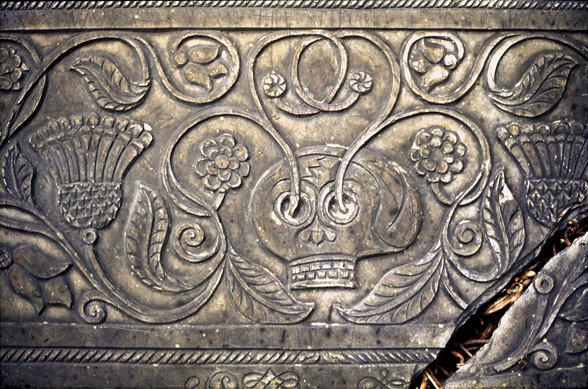
If this Save is failed the person examining them becomes Entangled, and is then attacked by one of the Foliated Men (also explained below). The Foliated Men will try to tackle or shove them down into a sinkhole, which widens just enough to fit them. If an Adventurer goes down a sinkhole they are consumed by the Forest, and soon appear as an additional Foliated Man.
A successful Language roll by a Magic-User reveals ideas of enchantment, protection, and sacrifice from the carvings.
⚪ Ruined Encampment
Perhaps 9 people or so were encamped in this clearing, but now it's ruined and completely empty. It's a mess, and blood was spilled. There was chaos, a battle, and panic. Some rudimentary camping supplies can be found here if one wants to dig around, and maybe a tent and a few bedrolls are salvageable too. There is a backpack with some correspondence in it. A letter that says that the "items" are buried near the "Witchery Stone" under a "round river rock". It adds as a post-script "and don't go looking at the stone, it surely won't do you good".
Twenty Locations & Events
They cough and wheeze, and are visibly unwell. They refuse all medicine, all aid. They have lived an unfortunately long time and are thankful that they are about to end. It shall be a day or two.
They have sense like an animal, and can tell if you are lying to them 4 times out of 6. If you lie to them they’ll become silent, and turn away from you. They will not fight back if attacked, and will never speak to you again.

The only things that exist in the forest for them are humans (or other sapient beings) that possess weapons. Their only goal is to kill and eat those beings. They appear according to unknowable and sadistic whimsy. (something perfectly simulated by die rolls).
The three of them:
Rodolf
covered in mud, blood and leaves, they are plastered all over it. It is unclear how it is able to see, as there’s large leaves all covering it's face. You can tell that it was Rodolf from the wide shoulders, lean frame, and big strong hands. Some freckles are still visible through the dirt.
16 HP
If the Adventurers watch a Foliated Man while moving away there is a 1 in 3 chance another one of them is encountered, possibly all 3 could be seen at once. If all are watched carefully the Adventurers can leave the area without any chance of attack. The Foliated Men then vanish once out of view, until called forth by randomness again.
If killed they are simply dead, their weapon can even be taken. If rolled as an encounter again they appear as if nothing had ever happened.
During Overnight Watch roll to see if there is an encounter once during each watch shift. If watched unwavering and unmoving for a longish time (say an hour or so), a Foliated Man will suddenly try to Vanish. Sleep deprivation is one of their intuitive tactics. If no one takes watch one Adventurer (or Hireling) will be killed in their sleep if there is a random encounter.
Those who carry no weapons are invisible to them. If one abandons all their weapons (as in: discards them with no intention of getting them back, actually loses them, or willfully ruins or destroys them), they cease to exist to the Foliated Men, and are no longer Entangled if they were before.
(Note this is a matter of true intention, not pedantry. If someone discards their weaponry and has someone else pick it up for them they haven't actually abandoned their arms.)
Acquiring weaponry when one had none before, or re-acquiring weaponry after abandoning it, causes one to become visible to them again.


And here are two maps, premade using the content from above. 10 Locations, 4 Intersections, and two extra rolls for paths. Rolls were 1d6, 1-4 for one path and 5-6 for two. The intersections were chosen at random, those are the black dots. Each room could have four connecting paths at most.
The table had the Witchery Stone as 1 and the Ruined Encampment as 10. Each square is a half-day of hiking.


1. Encampment
2. Cavern
3. Tree (14)
4. Lakeside (5)
5. Berries (7)
6. Flowers (17)
7. Pond (9)
8. Birds (18)
9. Insects (19)
10. Witchery Stone
This one showcases more of the hostile fauna, of which the other map had none, but it still includes the Cavern. There's no Druid to give them a hint, either.
This method and these maps aren't playtests, at least yet, but let me know if you think it's neat or just use it and have fun.
I'll post the other method once I have a name for it.
To give a broad summary: the Adventurers decided early on that they would keep the money that was given to them to purchase the special object with, so they buried it beneath a tree.
Then they did some espionage on the vagrants, determined they weren't worth talking to, and then stole the special something right out from under them. They also slightly vandalized the thing, neutralizing a potential curse they weren't aware of. There was a perilous cave that I had mapped out that they could have explored too, but they decided not to go inside it (this was the smarter thing to do, but still: darn).
They killed the leader of the vagrants (by accident), then killed two dozen of them with a carefully timed combination of spells (Wall of Force combined with Reverse Gravity is hideously effective if a lot of people are angry at you, and running).
A tagalong hireling of theirs was also traumatized with hallucinogens early on, and someone else was mauled by a delirious stag. The apocalypse was simulated with skinned bodies (this was the players idea, not mine).
To cap it off, once they got back to Aldercliffe they sent some mercenaries they had recently met out into those same woods under false pretenses in the hope of causing a massacre to clear the place out.
I loved how it all turned out. The players interacted with all the moving parts in this situation in ways I never would have predicted, and it produced a very memorable outcome for everyone. Why are you here? What more do you want from this hobby?
What didn't work for me was the whole "exploring a forest" bit. It just felt like a big room with some distractions on the way, like opening the door to a mansion and immediately seeing the high backed chair before the fireplace, with the weird lord seated within. You trip on an umbrella walking over. That's it though, you go and meet him. Ho-hum, too quick too easy.
The woods were far too small, too close to civilization, and too simple to get through. The Adventurers couldn't help but run into a situation and take it from there, and they basically got back in time for dinner too. It was fun to play through, but that part wasn't really special.
I'm revising it to make the forest much farther so it's more of a journey. The forest is larger too, large enough that there's a chance the Adventurers might think "fuck it, there's nobody here" after a couple days of wandering.
I'd like it so there's the chance they might get mauled by a badger and call it all off on day three, or maybe they might find a half-trapped fox and think they should keep looking. They might see smoke from a bonfire, another long day away. Maybe they'll run into someone in the woods that makes them want to reconsider everything just as they get near the edge of discovery. There's also a non-zero chance they'll just find the treasure on accident. How did it get there? They can keep looking for an answer for that if they want to know.
That's way better than a day trip to the stupid woods, right? Watching people actually stock up and plan for a camping excursion in-game, with rations and water and mules and carts and tents and all is actually kind of fun too. "oh no we didn't buy tents" and all that.
So yes, version 2: if they decide to go there's a longish journey, maybe there's an encounter on the road. It's distant and lonely though, isolated no matter what. They reach the woods, and they go inside them. And they look. They find some things, maybe the thing, maybe others. Maybe nothing at all.
The old version was basically just two encounter tables. This version of things needs more of a map, I think. I've been hammering out a couple ways to make maps that are mostly easy and quick to make, but still create interesting results, and should be fun to use at the table. I thought of name for this method first, so here that is.
Open Air Dungeons
Much of the uninhabited and untamed world is like this. There are only a few ways you can actually "go" in a lot of natural environments.
Ground that's too steep to go up without climbing gear (and hours of labor) is functionally the same as a stone wall. Trees too dense to walk through and narrow paths on mountainsides are the same. There is natural light, sure, and maybe a source of food, but it's not too different than being trapped. Missing people die in the woods all the time. Even being able to bypass these kinds of obstacles with flight is only marginally easier than being able to escape a place with teleportation, after all.
The idea of an open-air dungeon is that it should be about as hard to not use the defined paths it provides as it would be to tunnel out of the more usual stone dungeon with mining tools. Not technically impossible, but a real piece of shit to actually do.
In nature, the pathway is the "hall" that lead to the "room". The "room" is an event or landmark. A mountainside path leading to a wider plateau, a rocky band of cliffside coast leading to a larger cove, a narrow canyon eventually widening to a proper valley, a hike in dense woodlands to a roaring waterfall. These are all Open Air Dungeons.
Wandering encounters make as much sense as those in a dungeon, think of hikers getting mauled by a bear. There are traps too, a landslide is natures spike-filled pit trap.
The natural world is a dungeon whenever you can't go in any direction you want.
Making an Open Air Dungeon
You'll need an environment, some random encounters for that environment, and a bunch of things you want to be discoverable in that environment. Tables of content.Give your environment a name. It's not just "a canyon by a beach", it's "The Throat of the Ocean". Make it special.
There should be some plain old random encounters on a table, things there that will be run into by accident on the way from one room to another, or even in a room if one hangs out too long. In the Black Heart of the Southern Wood: there are Elk that went carnivorous, paralytic slugs the size of baseball bats, and hopelessly lost mushroom-pickers who will be very grateful that you found them.
And there are things there besides the pathways and random encounters, the special parts. Imagine a vast tidepool canyon, walkable in the low tides. If you go that way there's a stinging anemone the size of a house. It has the face of a maiden and will teach you enchantment. If you go the other way you'll find an immense band of gold in the walls of the rocks. Beyond that, they say there's the wreckage of a ship sent by the church, filled with relics now lost to the saltwater. If you go too far there's a bunch of sharp rocks though, watch your knees. This will be a table as well.
Once you have all those things you get a sheet of paper and a marker or something.
- Draw a square near and edge of the page (I prefer using corners, but do whatever feels right).
This is a landmark, a signpost, the signal that there's something to explore. It's like the bit of a lost monolith you see distant in the jungle. - Draw a line out from the square, and add a triangle.
This is the door to the dungeon. All movement beyond this is constrained. Imagine a tiny opening between two big mountains. - Beyond the triangle draw at least as many circles throughout the rest of the page as you want there to be "rooms" in the open air dungeon, extra ones will be "intersections" that act as empty rooms. These shouldn't touch, or be evenly spaced.
You'll have to decide how spacious a path actually is, but the aesthetic of your Open Air Dungeon will help with this. If the OAD is a mountain the paths can all be narrow with dense pines on either side, maybe just a a few meters at most. If it's an arid canyon it could be an ancient riverbed spanning more than 30 meters in either direction with nearly vertical walls on both sides. You get the idea.
Paths are drawn quickly using arbitrary rules, with as little thinking as possible beyond obeying the rules. You want to create something using a process instead of trying to design something conciously.
The basic rules are:
- the number of paths drawn at each step is randomly chosen. (e.g 1d4, 1d8 where 1=1, 2-3=2, 3-5= 3, 7-8=1, whatever)
- there is a limit on how many paths any circle or triangle may have to it.
- paths do not cross, but do not have to be straight, and can be any length.
- Path drawing is finished once all the circles are connected to at least one other circle, and are reachable from the entrance, but adding some extra paths beyond this is recommended.
You can use small numbers and still get interesting results. Besides that most dungeon rooms aren't 4 door situations anyway.
The last step is to create a grid by folding the paper you've been drawing on. In "game time" the time it takes to travel across one square, from one line to the next, is enough for one encounter roll. It can be a half hour across one square if you want, or a whole day.
Some lines will be a weird length, but the idea here is just to use a quick (but fair) estimation with the grid. Don't get out a flexible ruler or anything. If a path is really short just treat the "rooms" as connected.
Here's two examples. The formula was 10 circles, rolling 1d6 to vary the paths. 1-4 was 1 path, and 5-6 was 2 paths. Each circle could only have 3 paths at most. After everything was connected there was one additional roll.


So there you go, this gives you a map with some various paths leading to various places where things will be. Once you decide the scale of the grid and travel time and decide how you'll fill the squares it's basically ready for play.
When it comes to stocking the locations you can key the whole map in advance, just use randomness to stock it. Roll dice, throw darts, whatever.
You can set it up so you can roll to reveal things as the map is explored during play, which is way more fun.
You can just roll off your table of content from earlier at each location. If there are some things that have to be present you can just make a "loaded" table to use during play. That means a few of the entries get written in, but the rest are "roll on this other table"
So, if this was The Forest of the Bitter Fruits and you definitely have to have the Red Tree of Bitter Fruits be there no matter what, you can make a table like this (for a map with 12 circles):
1. The Red Tree of Bitter Fruit
2-12. (roll on that d30 table of other things, don't repeat any of them)
and so on. If you added intersections to your map just choose them at random before play, of it all fits on a die load them into the table too. You can just fill in those circles on the map instead of numbering them.
You can make a whole Adventure around a map like this by thematically unifying your tables of content and giving them a way to play off each other and create a narrative. As Referee you'll have a notion of what might happen and you'll know a few concrete things, but you won't know how it'll all fits together until you explore it with the players.
So here's an example of that, some tables of content and two example maps at the end to show you how it go.
Malculmus Forest & The Witchery Stone
PREMISEThe Adventurers have heard about a gang of thieves planning to retrieve a cache of peppercorns and other exotic spices worth 2500SP buried deep in Malculmus Forest. They're trying to get it instead.
Malculmus is a wild tangle of dense woody valleys between a series of steep hillsides. It is rumored to be home to faeries and other malicious woodland spirits. Folktales even mention a great "fae rock" in these woods, and that it should be avoided. Most who live near here do.
The only entrance and exit that doesn't require climbing over a treacherous hill is found in a small gorge a good ways off a poorly maintained backroad.
Inside the entrance is a clearing at the base of a few hills, where the valley paths lead deeper inwards. One notices right away that there are no sounds of life in this forest, none whatsoever. Convey this before the first random encounter is rolled, so there's a chance for minds to be changed.
The paths here are woodlands between very steep hills, a couple hundred feet wide.
While the Foliated Men exist nature is not giving, the woodland has become a kind of predatory, digestive place. Bushcraft rolls to find food do not receive the usual +2 here.
The paths here are woodlands between very steep hills, a couple hundred feet wide.
While the Foliated Men exist nature is not giving, the woodland has become a kind of predatory, digestive place. Bushcraft rolls to find food do not receive the usual +2 here.
The two essential places in Malculmus are the Ruined Encampment and Witchery Stone.
 |
| https://bit.ly/2wzPiJZ |
⚪ The Witchery Stone
A large boulder in the off-center of this clearing. It stands out from the rest of the landscape, almost like it was spotlit without being any brighter. There's an irritating humming feeling in the air.
It seems to be covered with very faint carvings. This is noticeable from a good distance away, but these can only be examined when very close. There are 3 small sinkholes near the front as well, each like the opening for a gutter. You have to stand very near the sinkholes to look at the carvings, leaning over them. The sinkholes, if probed, go very deep. They seem too narrow to fit through.
Anyone who looks at the carvings must Save vs. Magic.
If this Save is successful they can see that they're a surrealistic blend of men and weaponry and skulls entangled by foliage. They feel like they'll develop a migraine if they continue looking (and this is true).
If this Save is failed the person examining them becomes Entangled, and is then attacked by one of the Foliated Men (also explained below). The Foliated Men will try to tackle or shove them down into a sinkhole, which widens just enough to fit them. If an Adventurer goes down a sinkhole they are consumed by the Forest, and soon appear as an additional Foliated Man.
A successful Language roll by a Magic-User reveals ideas of enchantment, protection, and sacrifice from the carvings.
A Search roll reveals an area of recently dug earth underneath a round river stone a few yards away. 3 feet underground is a hefty vessel (Oversized) filled with valuable peppercorns and spices worth 2500SP
⚪ Ruined Encampment
Perhaps 9 people or so were encamped in this clearing, but now it's ruined and completely empty. It's a mess, and blood was spilled. There was chaos, a battle, and panic. Some rudimentary camping supplies can be found here if one wants to dig around, and maybe a tent and a few bedrolls are salvageable too. There is a backpack with some correspondence in it. A letter that says that the "items" are buried near the "Witchery Stone" under a "round river rock". It adds as a post-script "and don't go looking at the stone, it surely won't do you good".
Twenty Locations & Events
1. Island
A lake with an island in the center, the island 50 feet or so across, about 100 feet from shore. A figure can be seen on the island, watching the Adventurers. It looks almost like a Foliated Man, but it carries no weapon. It will cross it’s arms at long distance communication, and beckon them over instead. They'll have to swim.
This is the last druid of Malculmus, and they have come here to die. There are other bones on the island, Druids leave no other traces. They have not spoken to another person in dozens of years, so their speech abilities are minimal, but they are approachable if you are not violent towards them.
This is the last druid of Malculmus, and they have come here to die. There are other bones on the island, Druids leave no other traces. They have not spoken to another person in dozens of years, so their speech abilities are minimal, but they are approachable if you are not violent towards them.
They cough and wheeze, and are visibly unwell. They refuse all medicine, all aid. They have lived an unfortunately long time and are thankful that they are about to end. It shall be a day or two.
They have sense like an animal, and can tell if you are lying to them 4 times out of 6. If you lie to them they’ll become silent, and turn away from you. They will not fight back if attacked, and will never speak to you again.
“Why here?” they ask you. “Touched stone?” they’ll ask too, laughing at the answer. “All will die”. They imitate gnawing.
They know that those who carry no arms will not be harmed by the Foliated Men.
They know that those who carry no arms will not be harmed by the Foliated Men.
If you promise to "protect this home" they will tell you how to "not be eaten". They swear you will die if you break your oath, but that's not true at all. The magic of the druids has been long forgotten. (perhaps you could close off the entrance with a landslide or something.)
The druids of Malculmus created the "Witchery Stone" centuries ago as a means for defending against invaders, and attempts to clear or otherwise exploit the forest. A druid or two would sacrifice themselves to the stone, while the rest would wait out the carnage unarmed and isolated.
2. Witness
Randomly choose which Adventurers hear the sound of a snapping twig. The other Adventurers are Surprised.
A figure can be barely seen in the brush, along with the glint of metal. Roll for initiative.
On the figures turn they’ll stammer out “wait!”
This is Burtold (Level 1 Fighter, 8 HP, Dirk 1d6, Armor 13, Morale 7). He is armed with a sword (1d8).
He was with Nirnus, Golfawn, and Rodolf when they examined the Witchery Stone, and he saw them vanish into the sinkholes. He hasn't seen the Foliated Men yet, but he's seen what happened to the camp. He's trying to find the others. He has digging equipment too.
3. Fingers
Two bodies lying in a clearing, surrounded by thick brush.
One body is missing fingers that have been enthusiastically hatcheted off, in addition to its other wounds.
The body near it is nude and face down and almost covered in twigs and vines, they're even entwined in its hair (it is an instance of Golfawn). It has the missing fingers in its mouth, all chewed up. It’s been chopped across the spine with a few sword blows.
One non-Entangled Adventurer who examines this body will see the same face peering out at them from the distant brush when they look up, and then must Save vs. Magic or become Entangled. If successful they only see leaves rustling, just as if something were there, but nothing can be found.
4. Larder
A gorge with dozens of very old skeletons in it, all have been gnawed clean by human teeth. There is a tree growing through them. There are very old and rusted weapons near them too. Two bodies are fresh, one a wet skeleton with ragged bits left on it, the other still flesh but clearly chewed on.
If any bodies were seen and not destroyed in some other way in other locations they will now be here, atop the pile, also gnawed almost clean (but with enough left so they're recognizable).
The Foliated Men return here to feed periodically, but this will never be seen by the Adventurers, just the after-effects. If they are encountered they might be seen standing before a body transported with them.
5. Cavern
A hole in a cliff face leads to a habitable cavern, the size of a small cabin. As the odd rules of enchantment dictate: this place is not part of the forest, it is in the realm of the underground. It acts like a safe pocket from the mayhem outside, and the Foliated Men cannot enter it. It contains no food or water, but may lead deeper into the underworld.
6. Ravine
There is a large fallen tree overhead. A randomly determined Adventurer who is not Entangled sees a leaf fall in front of them, and they glance up. They must Save against Magic. If they Succeed they see movement, like figure turning away, fleeing atop the log. There sounds of footfalls, the bending of it under a weight. Nothing is up there.
If this is failed they are staring into the Face of Nirnus, a drop of blood falling from his leafy mouth onto their face. They must Save vs. Magic or become Entangled. Roll for surprise and initiative, Nirnus Charges them by dropping on top of them with a sword blow.
7. Berries
A thicket of bright green berries. They are bitter but edible. There are 1d4 rations worth to be found. They curl away from being picked, very subtly but visibly.
7. Berries
A thicket of bright green berries. They are bitter but edible. There are 1d4 rations worth to be found. They curl away from being picked, very subtly but visibly.
8. Mushrooms
A large and ancient oak tree, with a large cluster of thick-stemmed yellow mushrooms with brown caps growing beneath it between the roots.
There are 1d6+1 edible rations worth, but those who eat them have a 1 in 6 chance of being afflicted with diarrhea and ending up both starving and dehydrated afterwards, unless they make a Save.
If there is a random encounter Rodolf is up in the branches, and if he gets surprise he will drop down while swing, which counts as Charging.
9. Pond
A small pond. There are fish in it, but they all swim directly down and away from the Adventurers to the bottom, and will not take any bait if fished for. It will take an extremely long time to catch any.
A small pond. There are fish in it, but they all swim directly down and away from the Adventurers to the bottom, and will not take any bait if fished for. It will take an extremely long time to catch any.
10. Hollow
A randomly determined Adventurer looks towards a grove of trees and sees a tall hollow stump.
They must Save vs. Magic.
A randomly determined Adventurer looks towards a grove of trees and sees a tall hollow stump.
They must Save vs. Magic.
If Failed they see a leaf covered figure crawl out from inside the stump and begin bounding towards them, only to vanish between two trees. Roll for suprise. If failed they are attacked from behind. If successful they hear this instance of Rodolf just a few yards behind before he strikes. They must Save vs. Magic or become Entangled.
If Successful they feel like the hollow of the tree is gazing at them, but there's nothing inside it.
11. Boulders
There are many very large boulders to walk between in this area. Unless someone makes the effort to climb over them to watch for an ambush one of them has Nirnus behind it, and the first Adventurer in line will be attacked with surprise 5 out of 6 times. Those who look for an ambush will see Nirnus, and if not Entangled will lock eyes with it and have to Save.
12. Duel
Seen in profile, a man staring into the brush. He is holding an axe, as if waiting for something to charge at him. Leaves are piled around and on his feet, he is Entangled. If spoken to he’ll flip around startled, and once realizing the Adventurers are human will look back at the brush. “It’s fucking gone!” he’ll shout. It was Golfawn. Roll for Surprise again.
Tymus, Level 2 Fighter. Armor 15, Axe 1d8. Morale 8.
13. Poachers
Have the Adventurers roll their Search. If successful, they notice two figures trying to hide in the brush up ahead. If none are successful they’ll hear a loud whisper from that brush as they walk by, two poachers who have heard distant screams. Birk claims to have seen a "wild nude", and is entangled. Dola has not seen any nudes at all. They will travel with the Adventurers for safety. They are level 0, carry crossbows, and have morale 6.
14. Tree
A mighty tree in the very middle of the narrow trail. If it is walked by one at a time Nirnus is behind it, with sword ready to swing. The first in line sees his sword tip just before he swings around the other direction, to strike the person behind the lead. Roll for Surprise, if the first in line acts first they are able to warn the potential victim, giving them a chance to roll initiative instead.
If two walk around each way they see the branches above sort of rustle, but there is nothing else.
15. Snare
The sound of a trap being sprung up ahead. The first in line, if not Entangled, must Save vs. Magic as they continue onward.
If failed they see Rodolf caught in a snare and hanging upside down in the branches. He makes eye contact, they must Save or be Entangled. He can’t attack, but can sort of swing himself into the branches to Vanish.
If successful the sprung trap is swinging empty in the branches.
16. Slope
Going down a slope one is eye level with some of the tree branches.
The last in line must Save vs. Magic if they are not Entangled. If failed they are eye level with Golfawns face in a tree and must Save or become Entangled. If they pass they see bending branches, as if something heavy were just there and had sprung away.
17. Flowers
A field of wildflowers that are all directly turned away from the Adventurers whenever they are there, turning as needed.
In this wide open area the Foliated men will not be close enough to get real Surprise, so when encountered it's always a stand off.
18. Birds
All the birds of the forest are gathered here in the branches, silent and distant. If the Foliated Men are encountered some of them begin to fly in the Adventurers face, causing a -2 to hit and making it all but impossible to watch the Foliated Men to prevent attack.
19. Insects
All the insects of the forest that can fly are in a great low cloud, buzzing and drifting. Beetles and grubs are crushed and squished underfoot while writhing in spiral flows. Passing through place conceals the Foliated Men, giving them a 5 in 6 chance of having Surprise if they are encountered.
20. Lake
A narrow path near the edge of a lake, if the Foliated Men attack they attempt to tackle an Adventurer into the water and drown them. Foliated Men won't die from drowning. ENCOUNTERS
A narrow path near the edge of a lake, if the Foliated Men attack they attempt to tackle an Adventurer into the water and drown them. Foliated Men won't die from drowning. ENCOUNTERS
There is a 1 in 3 chance of an encounter through every square, and every 3 turns or so while in a location. If 5 or 6 are rolled more than once use a Foliated Man instead.
1-4. One of the Foliated Men.
5. A man, named Byrll is found unconcious or appears and then passes out. He was gouged in his guts by a sword, and finding him saves his life. He lost his sword in the fracas, and he's too weak to fight now. He just wants to escape, he claims to know of "other treasures" if they get him out alive.
6. A man with a crossbow, Dalkirk, appears or is seen looking around wildly and stammering. His right arm has been badly cut by a sword blow. He has been Entangled. He has Morale 5, and will do something idiotic if he fails his roll.
The Foliated Men
Four of the group who had intended to retrieve the spices drew the short lots, and so were sent to do the digging. The rest had agreed they would do the hauling. These were Burtold, Rodolf, Nirnus, and Golfawn.
Rodolf, Nirnus, and Golfwan had heard rumors that looking closely at the “witchery stone” hidden in these woods would grant them a boon of luck, or strength, or something like that. Burtold would have none of it.
Burtold witness as it claimed their bodies, and ran off in terror. The three were transformed them into anthropophagic guardians against violent invasion, part of a druidic enchantment they had activated.
They are all dead now, wholly unretrievable. These are just something that has their form, a paranormal phenomenon that looks like their skin: Foliated Men.
They are all nude now, dirty and bloodied and foliated in various ways. They appear and disappear throughout the woods, hunting down anything with a weapon. They must eat human flesh and viscera to avoid starvation, nothing else can nourish them, and they need no other nourishment. They don't sleep, get tired or thirsty, and they do not feel pain in any way that matters. They are also always silent, they never make a vocal or verbal sound. (though they seem to breathe). They sometimes have a smirk, a grimace, or a gaping wide expression.
If they are killed they’ll appear again, identical. The body will remain, at least for some time. (their bodies are very real, but the Foliated Men cannot eat them for nourishment). Their bodies become rotten, then vegetated skeletons, then simply plantlike silhouettes within a day. They have some blood, some gore, some guts, but are also stuffed with leaves and twigs and flowers and vines too.
If they are killed they’ll appear again, identical. The body will remain, at least for some time. (their bodies are very real, but the Foliated Men cannot eat them for nourishment). Their bodies become rotten, then vegetated skeletons, then simply plantlike silhouettes within a day. They have some blood, some gore, some guts, but are also stuffed with leaves and twigs and flowers and vines too.
The only things that exist in the forest for them are humans (or other sapient beings) that possess weapons. Their only goal is to kill and eat those beings. They appear according to unknowable and sadistic whimsy. (something perfectly simulated by die rolls).
They can vanish whenever they aren’t seen by something, and in the dense forest this is very easily done. Treat this like casting a spell: on the round a Foliated Man attempts to vanish it succeeds on its turn if nothing strikes it first.
The three of them:
Rodolf
covered in mud, blood and leaves, they are plastered all over it. It is unclear how it is able to see, as there’s large leaves all covering it's face. You can tell that it was Rodolf from the wide shoulders, lean frame, and big strong hands. Some freckles are still visible through the dirt.
16 HP
3 HD
Armor 12
Morale 12
It uses a sword that does 1d8 damage.
It tends to strike once and then vanish, preferring to attack the weakest. If all run away it will chase after to try and get one strike in. It appears from logs and up in branches, from leaves and trees.
Nirnus
There are leaves and vines and twigs disgorging from its open mouth, as if they were stuffed in there, all bloody now from devouring. The rest of it is all dirty and mossy, with the occasional branch bent across it, sometimes a tangle of thicker fronds across an arm, or on the torso. A mop of hair hangs in its eyes still, and it has a bushy beard, and the strength of it's body is very visible though it stands shorter than most men.
20 HP
4 HD
Armor 14
Morale 12
It carries a Zweihander that does 1d10 damage
It only attacks with Defensive Fighting (+2 Armor, -4 to Hit). It prefers to attack the least damaged of those available.
It does not try to vanish unless nearly dead, but will allow everyone to run away. It appears from behind stones, and tree-trunks.
Golfawn
Blonde, short cropped, with a long face and full lips. There are small blossoms, buds, leaves, and tiny vines squeezing out from between its teeth, out its ears and nostrils, around its eyeballs, through its hair. When it is seen it is just a face barely concealed by the brush. When it attacks this is glimpsed before he lunges out, all tall and thick-built with a hatchet swinging and its hairy body all covered in pollen and grassy debris.
Blonde, short cropped, with a long face and full lips. There are small blossoms, buds, leaves, and tiny vines squeezing out from between its teeth, out its ears and nostrils, around its eyeballs, through its hair. When it is seen it is just a face barely concealed by the brush. When it attacks this is glimpsed before he lunges out, all tall and thick-built with a hatchet swinging and its hairy body all covered in pollen and grassy debris.
3 HD
14 HP
Armor 12
Morale 12
He carries a Hatchet that does 1d6 damage
He only attacks as a Press (+2 to Hit, -4 Armor)
It will chase anyone who tries to run away, and will only vanish after it has killed someone.
Encounters
There is a 4 in 6 chance the Foliated Men will have surprise, and if so they Attack in Melee Range. If they do not have Surprise roll for Encounter Distance, and then randomly determine which Adventurer saw them.
When spotted like this they will only Attack if the one who is looking at them is Entangled and then fails a Magic Save. Other than that they stand still there, stopping dead in their tracks. Up in a tree, near a shrub, standing on a boulder, and so on. If an unwavering unentangled eye is kept on them they will not move closer on their own. They stare back.
If gotten close to, or shot with an arrow or whatever, they will try to Vanish.
If the Adventurers watch a Foliated Man while moving away there is a 1 in 3 chance another one of them is encountered, possibly all 3 could be seen at once. If all are watched carefully the Adventurers can leave the area without any chance of attack. The Foliated Men then vanish once out of view, until called forth by randomness again.
If killed they are simply dead, their weapon can even be taken. If rolled as an encounter again they appear as if nothing had ever happened.
During Overnight Watch roll to see if there is an encounter once during each watch shift. If watched unwavering and unmoving for a longish time (say an hour or so), a Foliated Man will suddenly try to Vanish. Sleep deprivation is one of their intuitive tactics. If no one takes watch one Adventurer (or Hireling) will be killed in their sleep if there is a random encounter.
Entanglement
Anyone who is Entangled cannot leave the forest.
If you try to walk out of it you'll simply not ever reach the edge. If someone tries to drag you out their hands will always slip, and you’ll get something caught, and you’ll never make it out. Something will get in your eyes, you’ll stumble, and then there you are a dozen yards back into it.
While you are entangled leaves seem to catch you on you more easily, mosses stick to you, twigs get caught on your jacket, and you become muddy and covered in thistles with ease. If you stand very still any little soft branches or vines will very delicately start to wrap around you very slowly. If you manage to sleep you’ll awake with plants all over you, holding onto you.
Any Adventurer attacked and injured by a Foliated Man must save against Magic, if this is failed they are Entangled. Any Adventurer that gazes on a Foliated Man, and has their gaze returned, must also save or become Entangled after they have stopped gazing on them Foliated Man.
Survival
You cannot directly kill the foliated men, but there are ways to escape.
If you are not Entangled you can simply leave Malculmus, they cannot follow you. If everyone leaves at once have all three Foliated Men watch them go.
If the Foliated Men run out of bodies to eat they will starve. They each need one full body per day, or they lose half of their maximum HP. They vanish forever after the last one is lost. Since there are a finite number of bodies in the woods a war of attrition is possible.
Those who carry no weapons are invisible to them. If one abandons all their weapons (as in: discards them with no intention of getting them back, actually loses them, or willfully ruins or destroys them), they cease to exist to the Foliated Men, and are no longer Entangled if they were before.
(Note this is a matter of true intention, not pedantry. If someone discards their weaponry and has someone else pick it up for them they haven't actually abandoned their arms.)
Acquiring weaponry when one had none before, or re-acquiring weaponry after abandoning it, causes one to become visible to them again.
Any implement used to harm others is a “weapon” forever, but a tool is not a “weapon” until used as one. (if you ever hit someone with the shovel it’s a war shovel now) Things intended to be a weapon always already are one (no calling a new sword a letter opener, as it were).
If someone is really insistent on beating up the Foliated Men with their bare hands they will be visible to that Foliated Man after attacking them, until that Foliated Man is killed.
If the Witchery Rock was completely defaced or destroyed the Foliated Men would vanish, but this would require hours and hours of chiseling or a large cannon.
And here are two maps, premade using the content from above. 10 Locations, 4 Intersections, and two extra rolls for paths. Rolls were 1d6, 1-4 for one path and 5-6 for two. The intersections were chosen at random, those are the black dots. Each room could have four connecting paths at most.
The table had the Witchery Stone as 1 and the Ruined Encampment as 10. Each square is a half-day of hiking.

1. Encampment
2. Cavern (5)
3. Hollow Tree (10)
4. Slope (16)
5. Ravine (6)
6. Stingy Pond (9)
7. Mushrooms (8)
7. Mushrooms (8)
8. Berries (7)
9. Island (1)
10. Witchery Stone
This one has the mercy of the Cavern and the Island, and a good amount of free food instead of brutal ambushes.
This one has the mercy of the Cavern and the Island, and a good amount of free food instead of brutal ambushes.

1. Encampment
2. Cavern
3. Tree (14)
4. Lakeside (5)
5. Berries (7)
6. Flowers (17)
7. Pond (9)
8. Birds (18)
9. Insects (19)
10. Witchery Stone
This one showcases more of the hostile fauna, of which the other map had none, but it still includes the Cavern. There's no Druid to give them a hint, either.
This method and these maps aren't playtests, at least yet, but let me know if you think it's neat or just use it and have fun.
I'll post the other method once I have a name for it.


